2016-present

Typology Design
Client: Common Ground
It’s something of a mantra in urban design that to design the lot plan for a medium density subdivision you need to have designed all the houses first. Then draw the lot boundaries around the house. Since for all sorts of reasons you need the lot plan early in the design process and designing a single house takes days/weeks/months not minutes/hours, a large subdivision clearly presents something of a problem. The answer lies in ‘how’ you design the houses.
Read More
We’ve been working on this for the last decade or two as a ‘simple’ in-house design aid. In 2016 we made the jump and set out to develop a full stand-alone tool. The key has been to move from simple geometry to a rich data environment that can power a range of different applications. To date it has been picked up notably by Lots Co as the foundation tech for their multi-option, hi-resolution feasibility and development modeller. Concentrating on small-scale development, it has enabled cost savings of 85% and time savings of up to a year to achieve the same feasibility accuracy.
Apart from its obvious use as a design tool for medium-density subdivision at all scales, the design and data resolution of the tool has found application for the certainty it creates eg proving high-level planning assumptions, determining development value in court contested situations, and so on.
The ‘secret’ of the tool is to do with a practical understanding of how ‘typologies’ work at an academic and systems level. The power of typological thinking for architectural design is that it informs in an intelligent and coherent way. Applied systematically, it is capable of generating in very little time a (theoretically infinite) number of unique building designs, adapted individually to specific sites. Based on typologies, there is very little design overhead involved in converting a few starter designs into 100, 1,000, or 10,000 completely different looking buildings. Architects mistakenly talk about their housing ‘typologies’, when what they really mean is their house ‘types’ – a set of house designs that they are using in a project. A typology, on the other hand, is not an actual design.
- A TYPOLOGY is simply a taxonomic class ie a ‘word’ used to group objects. It is a geometrical abstract.
- A TYPE is a fully developed building design drawn from each Typology. It’s actually a kind of prototype, and for subdivision use typically results in a Type Set of 10—20 actual building designs.
- A VARIATION is any modifying procedure applied to a Type design so that it better adapts to a site. Variations form their own systemic hierarchy (V.1, V.2, V.3).
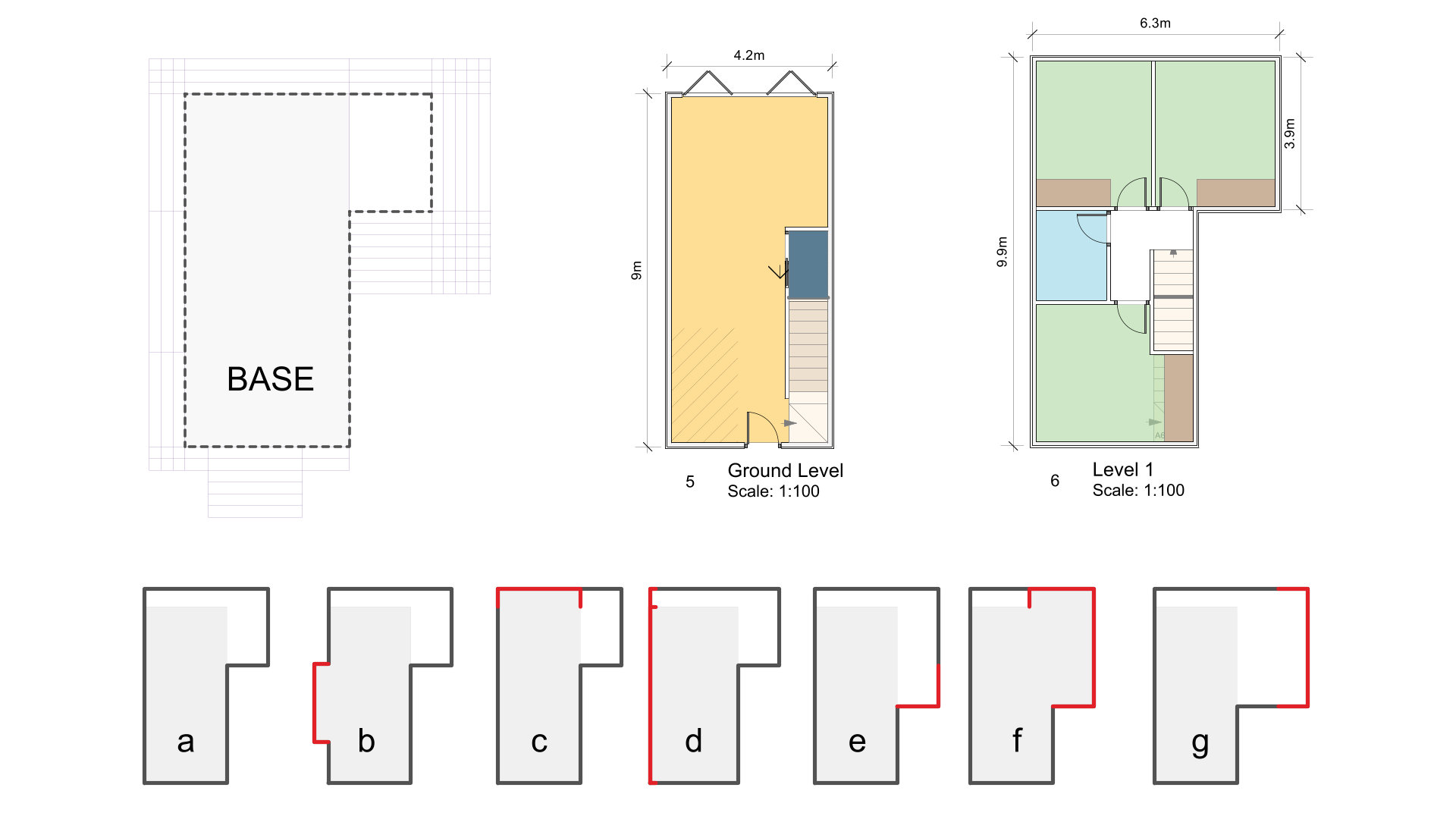
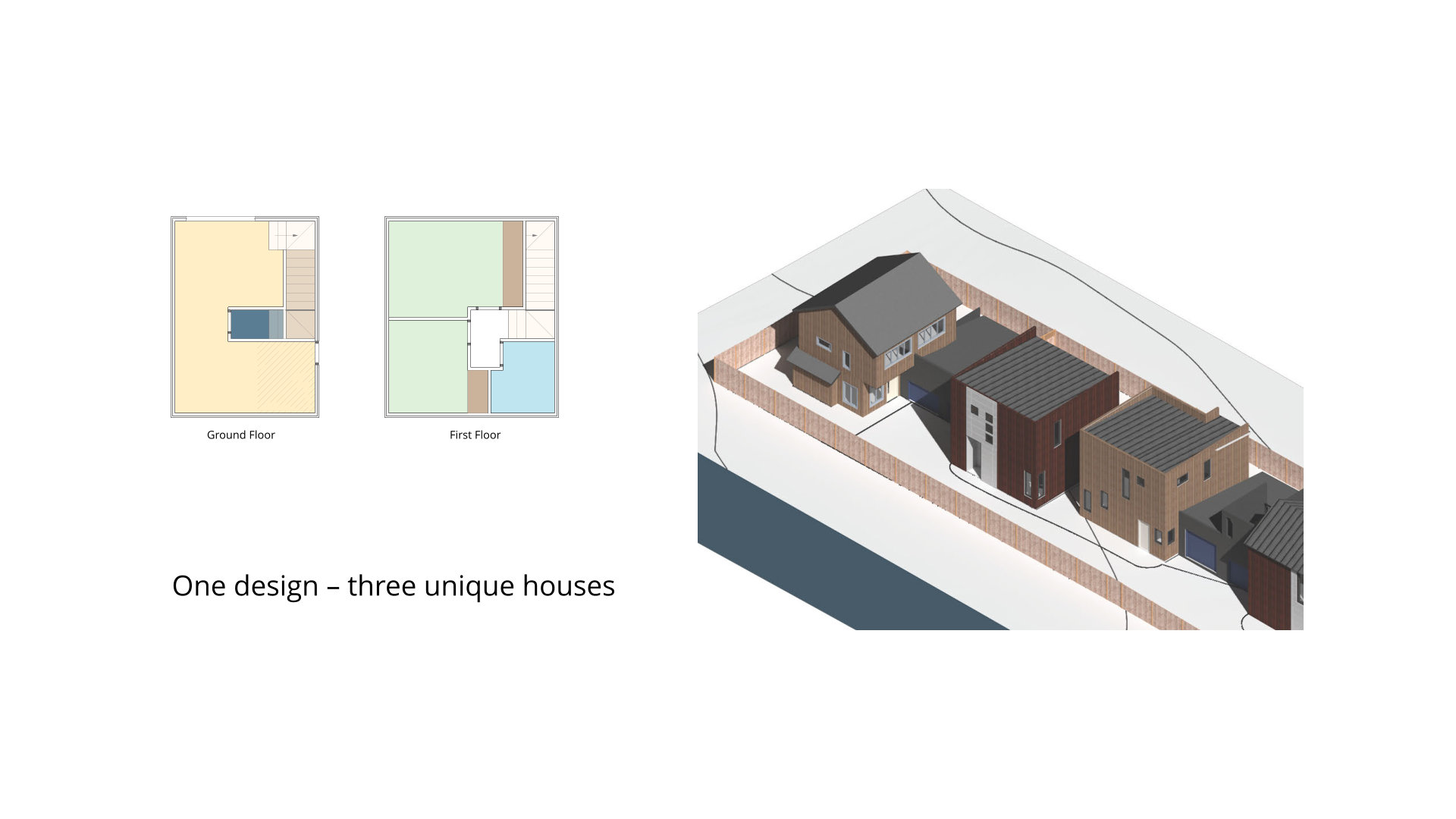
For medium-density housing, the appropriate classing is ‘lot dimension’. It results in two Typologies – a long thin rectangle and a short fat square. Initially, for both Typologies, 10 houses were fully designed as primary Types, differentiated mainly by different stair configurations and bedroom counts. The designs are the smallest and most spatially efficient version for each Type. These have been added to over the years and now number 33 including apartment forms.
Critical to the designs was the proportioning of internal spaces so that when the Type is manipulated to fit on a site, internal components (rooms, doors and windows) can also be rotated, mirrored, flipped etc independently within the building envelope and still maintain the integrity and efficiency of the Type design.
The Typology Design Tool
The purpose of the tool is to:
- Achieve certainty at the beginning of the development process
- Protect the efficiency and amenity value of the built-form outcome
- Provide hi-res data for development modelling and feasibility
- Determine consent compliance at the beginning of the design phase, not the end
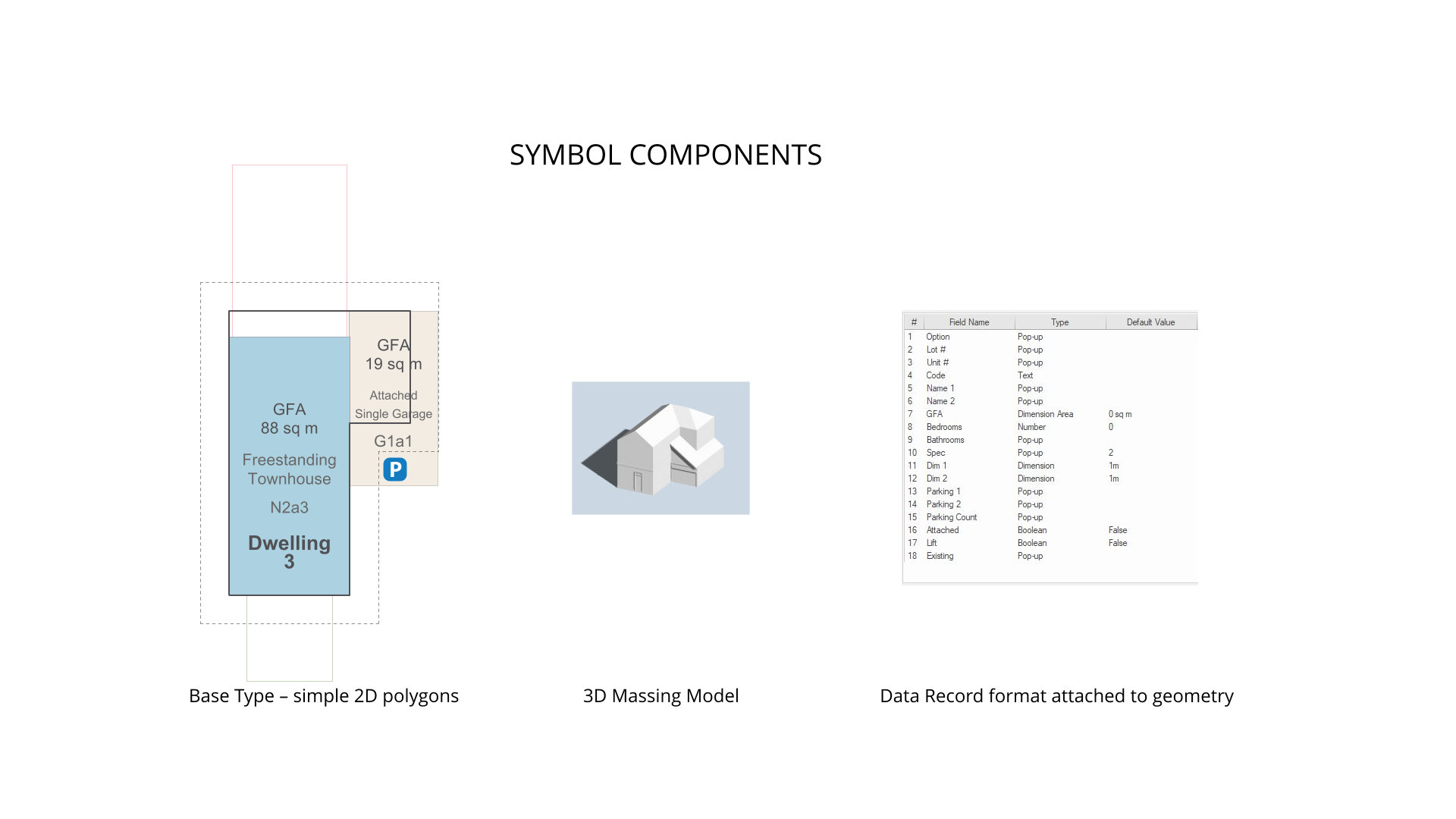
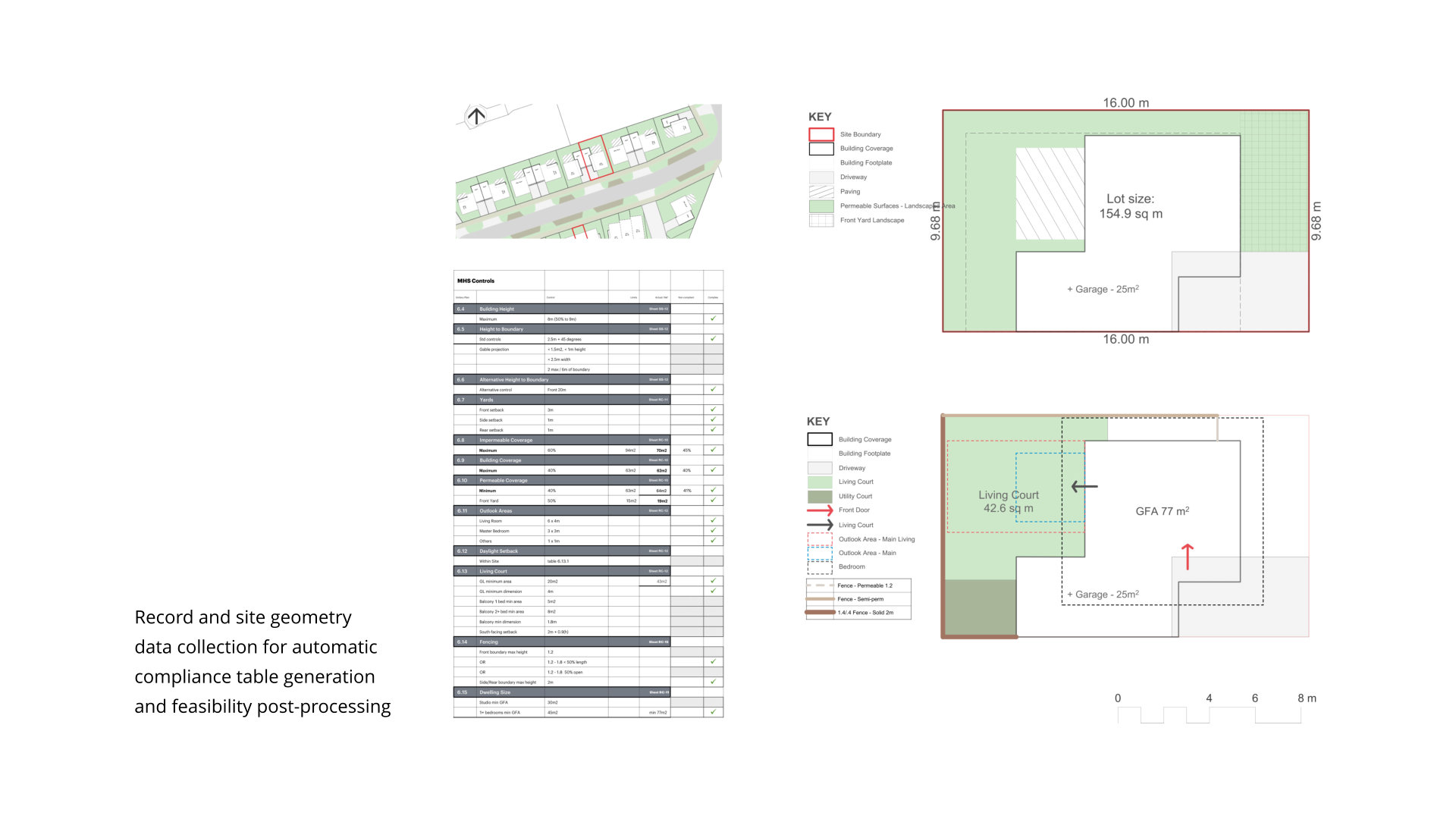
In practice, the tool uses composite 2D/3D/data symbols to populate a block scheme design.
The 2D component distils the full building Type design down into 3 polygons. Planning rules are built into the 2D layer as shapes to provide visual guides for the layout. The relationship between the 2D poly’s and drawn boundary lines generates a range of site data required for compliance and development cost calculations.
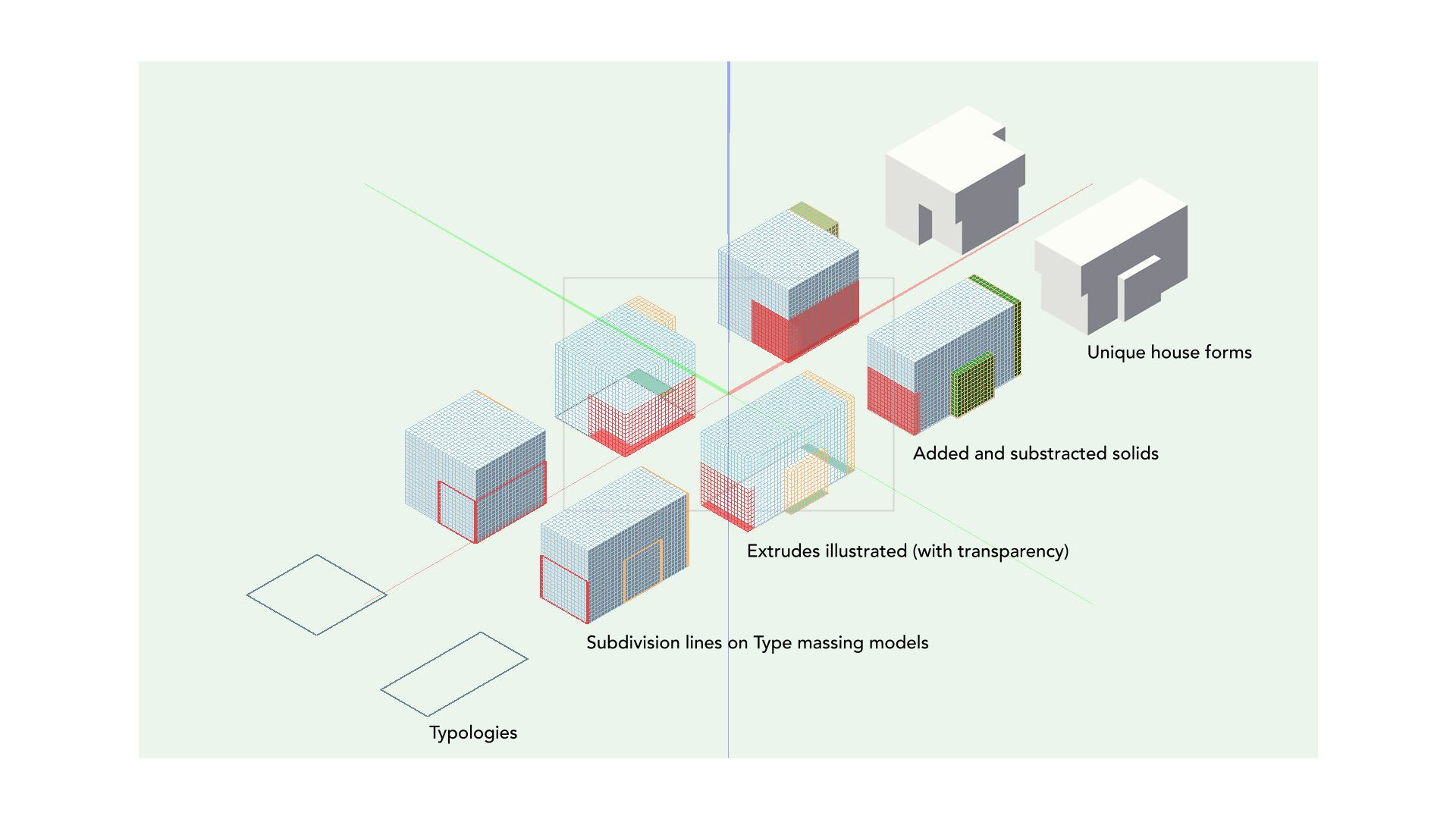
The 3D component is a simple massing model per floor. Roof configuration forms part of the Variation set.
Data records are applied to the symbols. Field values are used in the design environment to determine consent compliance and are also fed directly into external development and feasibility modellers.
A logical variation 0.3m matrix is applied to certain external walls on each type, giving a design resolution of ±0.1—.15m depending on wall construction and how they connect. Subdivision modelling is used on the massing models to extrude parts of walls.
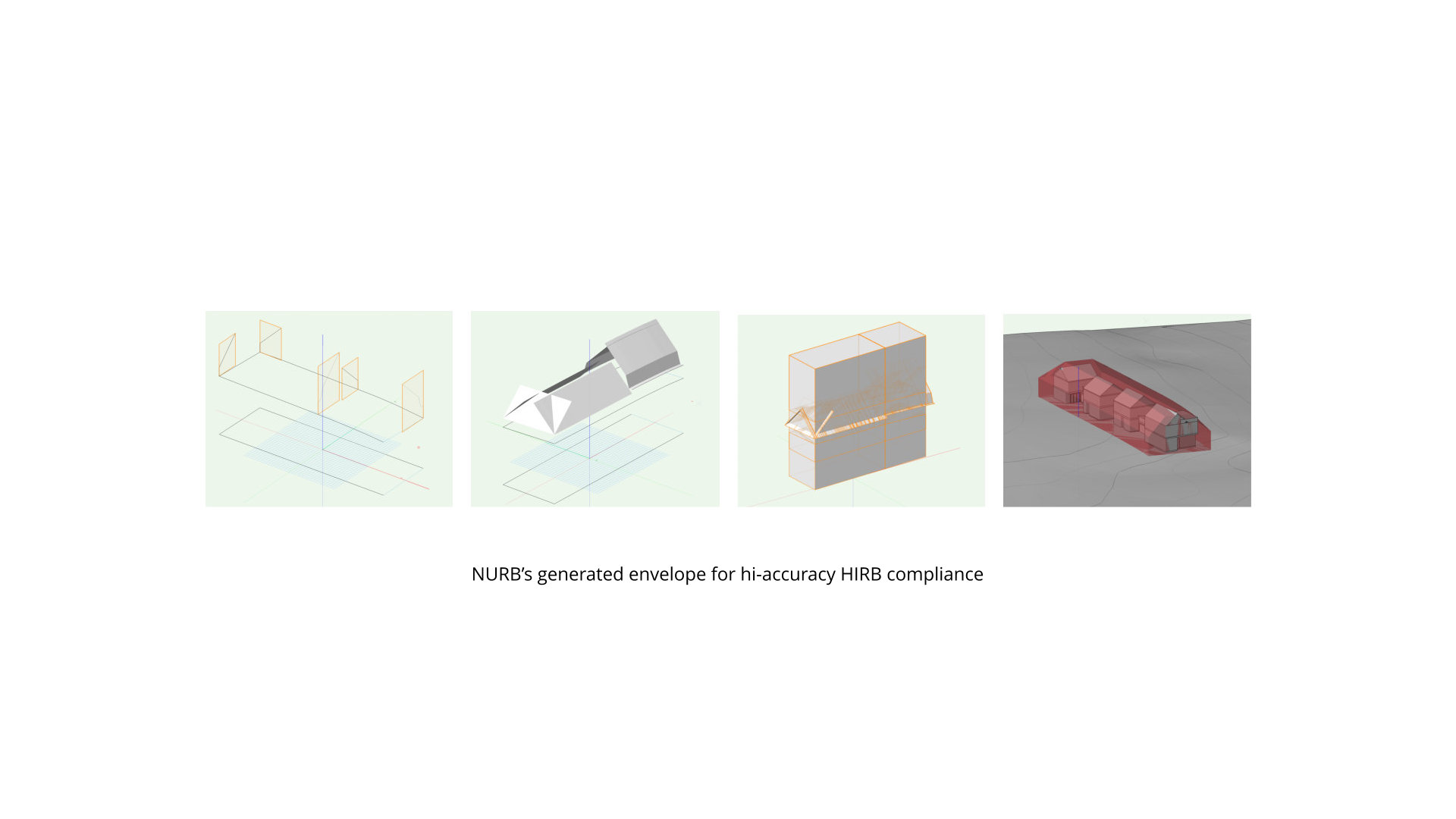
NURB’s modelling is used to generate accurate 3D envelopes and consent compliance using the massing model can be determined at this stage.
Roofs, fenestration and any add-ons are quickly attached as part of the variation sequence, and the resulting model forms the ‘briefing document’ for edits to the Type design and materiality required for Resource Consent.
- Typology System design
- Data modelling development
- Architectural Types design
- Tool components and symbol development
- ODB integration
Status
Current
Value of Project
n/a
Value of Consultancy Services
n/a
- Dramatically reduce timeframes for subdivision design
- Dramatically reduce timeframes for Resource and Building Consent drawings
- Technology transfer to third party applications
- Feasibility proofing for Court use